
How to Build a Portfolio That Gets Clients


One of the questions I’m asked most is, “How many photographs do I need before I can start approaching clients?”
My answer usually surprises people because it isn’t really about numbers at all.
I’ve seen photographers with twenty photographs get commercial work, whilst others have a hundred images on their website and still struggle to attract clients.
The difference is rarely the number of photographs.
It’s the story those photographs tell.

Think about the last time you walked into a beautifully designed shop. You probably didn’t notice every individual item on the shelves. What you noticed was the overall feeling.
Everything belonged together. The colours worked. The lighting felt right. There was a clear personality running through the whole space.
Your portfolio should create exactly the same feeling.
It isn’t simply somewhere to keep your favourite photographs. It’s your opportunity to show clients how you see food, how you use light, how you style a scene and how consistent you are from one image to the next.
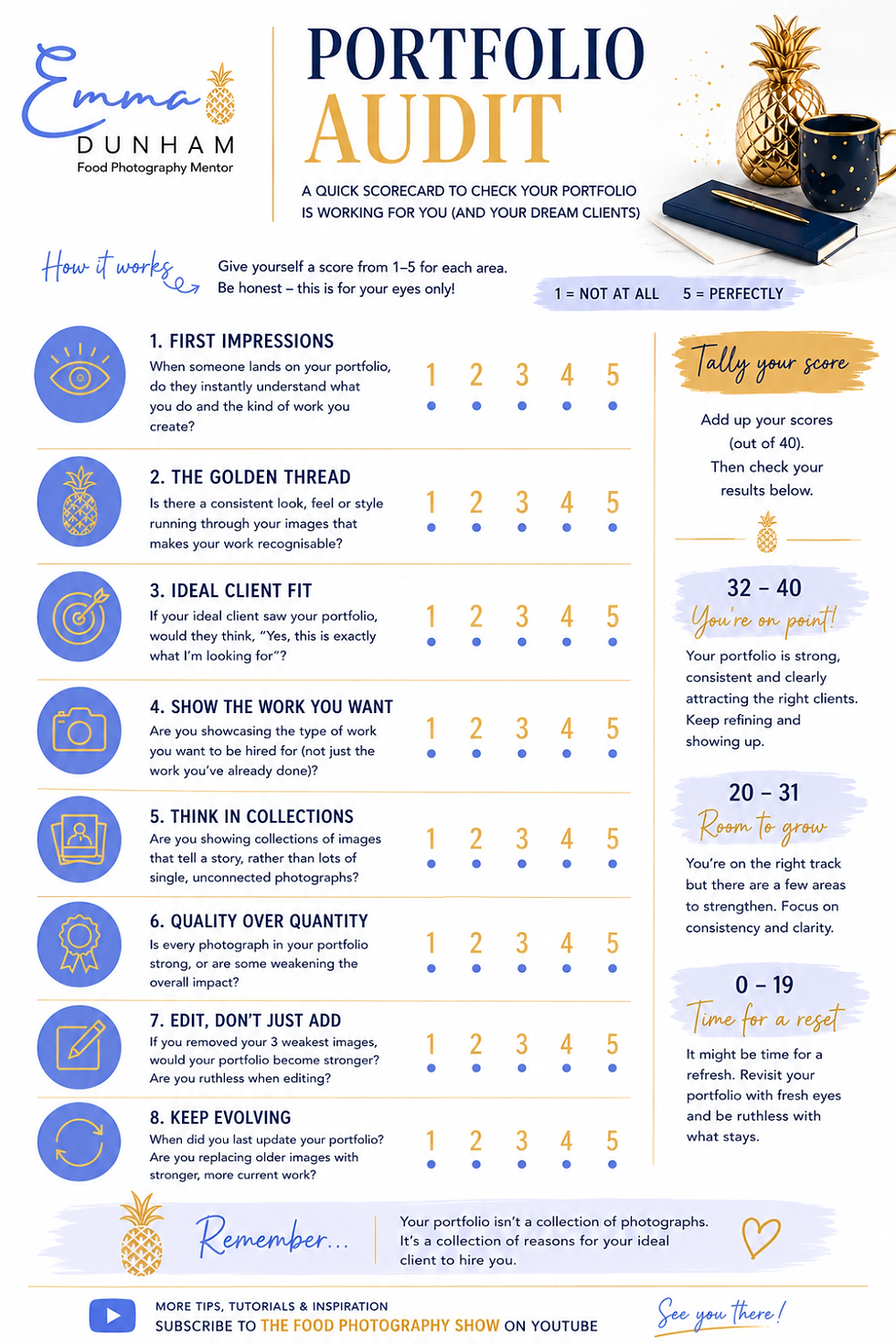
That’s what I call the Golden Thread.
It’s the thing that links every photograph together. Clients probably won’t be able to tell you exactly what it is, but they’ll feel it. They’ll start recognising your work because it has a consistency about it, whether that’s your lighting, your editing, your colour palette or simply the atmosphere you create.

One of the biggest mistakes photographers make is adding every photograph they’re proud of. I completely understand why. We all remember the effort that went into creating an image, the challenges we overcame and how excited we were when it finally came together.
Your client doesn’t know any of that.
They’re looking at your portfolio with fresh eyes and, within a few seconds, asking themselves one simple question.
“Can this photographer create the photographs my business needs?”
If your portfolio jumps from burgers to cocktails, then to wedding photography, back to artisan bread and finishes with a landscape from your holiday, it becomes much harder for a client to answer that question with confidence.
A strong portfolio isn’t about showing everything you can photograph.
It’s about showing the work you want to be hired to create.
That’s a subtle difference, but it changes everything.

When I talk about building a portfolio, I’m not talking about waiting until clients arrive. In fact, I’d encourage you to do exactly the opposite. If your dream is to photograph cookbooks, start creating cookbook images now. If you want to work with artisan bakeries, buy the flour, bake the bread and photograph it. If drinks brands excite you, create your own campaign.
Don’t wait for somebody else to give you permission to create the work you want to be known for.
Build it yourself.
The clients will then be able to see exactly what you’re capable of.
As your confidence grows, you’ll notice something else changing too. You’ll stop thinking about creating one great photograph and start thinking about creating a body of work.
That’s how commercial clients think. They’re rarely commissioning one image. They’re commissioning menus, campaigns, packaging, recipe books and social media content. The more your portfolio starts showing connected collections rather than isolated photographs, the easier it becomes for clients to imagine working with you.

Perhaps the hardest lesson of all is learning when to take photographs out.
Adding images is easy.
Removing them is much harder.
Every few months it’s worth looking at your portfolio with completely fresh eyes and asking yourself whether every single photograph still deserves its place. Not because it’s a bad photograph, but because your work has improved. Your portfolio should grow with you.
Every new image should raise the standard a little higher than the one before it.
That’s how great portfolios are built.
Not by creating one perfect gallery.
But by making hundreds of small decisions over time.
The Food Photography Show: Ultimate FAQ
How do I build a food photography portfolio?
Start by creating the work you want to be hired for, not simply the work you’ve already photographed. Build a portfolio that tells a consistent story and reflects the type of clients you want to attract.
What should I include in my food photography portfolio?
Include your strongest work with a consistent style. Show a variety of food, compositions and camera angles, but make sure every image supports the same overall look and feel.
How many photographs should be in a portfolio?
Around 15–25 exceptional images are usually enough. Clients remember consistency and quality far more than quantity.
Can I build a portfolio without clients?
Absolutely. Personal projects and self-assigned briefs are often the quickest way to build the portfolio you want and attract the clients you’re aiming for.
Should every photograph in my portfolio match?
No, but there should be a Golden Thread connecting them. Your lighting, styling, editing, colour palette or storytelling should make your work feel recognisable.
How often should I update my portfolio?
Regularly. Every time you create an image that’s stronger than your weakest portfolio photograph, replace it.
Should I specialise in one type of food photography?
Not necessarily, but your portfolio should make it obvious what you enjoy photographing and the type of work you want to be hired for.
What’s the biggest mistake photographers make when building a portfolio?
Trying to show everything they can do. A focused, consistent portfolio will almost always outperform a collection of unrelated images.
Whether you’re photographing your first brownie or pitching to your dream client, remember that your portfolio is already having the conversation before you ever get the chance to. Make sure it’s telling the story you want people to hear. Then subscribe to The Food Photography Show for more practical food photography tips and tutorials.
🍍 Remember…
Your portfolio isn’t a gallery of your best photographs.
It’s a collection of reasons for your ideal client to hire you.


Comments